
Buffalo County Deed Records Explained
A deed is a recorded instrument. It makes a transfer part of the public land record. The Buffalo County Register of Deeds keeps far more than deeds. Mortgages, easements, land contracts, satisfactions, transfer-on-death instruments, terminations of a decedent's interest, plats, and certified survey maps all appear in its deed records. Federal tax liens and lis pendens get recorded there too. The label on an instrument tells you what was filed. Its text and legal description tell you what land and interest it actually addresses.
| Deed Type | What It Does | Common Use |
|---|---|---|
| Warranty deed | Conveys the described interest with the promises stated in the instrument | Review the transfer terms |
| Quitclaim deed | Transfers whatever interest the grantor holds, without a title guarantee | Family or interest cleanup |
| Personal representative's deed | Conveys property through estate authority | Follow the probate order and deed |
| Transfer-on-death instrument | Names a future beneficiary subject to statutory requirements | Read the instrument and any termination |
| Land contract | Records a contract-based transfer arrangement | Check the later satisfaction or termination |
Deeds and mortgages are different records, even for the same property. A deed conveys an interest. A mortgage only secures a debt. An easement grants use without conveying the parcel. The Register of Deeds does not prepare documents, run title searches, give legal advice, or judge whether title is clear. Read the actual filing, and seek professional review when the outcome matters to a transaction.
Buffalo County Grantor and Grantee Index
Buffalo County's public page names Laredo and Tapestry EON as its two search products. It does not show the live search form's fields, document-type choices, cutoff year, image range, or result limit. So no specific online start date can be claimed. A grantor conveys an interest. A grantee receives it. To trace a deed chain, find the current grantee in the latest deed, note the grantor named there, and search that earlier owner as a grantee. Keep the legal description beside every name. That habit keeps a same-name result from being mistaken for the same land.
- Use the tax roll to identify the present owner and parcel, then search that owner as grantee.
- Open the newest matching instrument and note its grantor, date, and legal description.
- Search the grantor as a grantee in an earlier deed and compare the land description.
- Repeat until the portal no longer reaches the needed year, then ask about office or archive access.
- Grantor
- The party that transfers an interest in the instrument.
- Grantee
- The party that receives the interest described.
- Chain of title
- The ordered sequence of recorded conveyances for a parcel.
- Legal description
- The written land identification carried through deeds, plats, and survey maps.
Order a Buffalo County Deed Copy
Laredo is the subscription route for regular remote users. Tapestry EON serves occasional users, and non-members may search by credit card. One caution applies. An online image is not a certified copy. The Register of Deeds office at 407 S. 2nd Street in Alma takes in-person questions and copy requests. An uncertified copy costs $2 for the first page and $1 for each additional page. A certified copy runs $3 for the first page and $1 for each additional page.
A mailed or counter request needs details. Party names come first. Then add the approximate recording date. Add the instrument type. Include a legal description or parcel clue. The recording page accepts cash or check payable to Buffalo County ROD. Electronic recording is a separate option for documents submitted to be recorded. The fee schedule states no index-search charge or remote image cost. Call if the amount or format matters before sending payment.
Recorded, not guaranteed. The index identifies filed instruments, but it is not a title opinion and does not rule out unrecorded interests. A transaction-grade title search requires a qualified professional to examine the chain and releases.
Buffalo County Recording and Copy Fees
Recording a document in Buffalo County carries a flat $30 charge. That covers deeds, mortgages, land contracts, satisfactions, transfer-on-death instruments, terminations of a decedent's property interest, federal tax liens, lis pendens, and name-change documents. Transportation project plats also cost $30. Cemetery, subdivision, and condominium plats run $50. These are recording fees. Copies are priced per page instead. The schedule lists no online index fee.
Documents received during the stated intake window are recorded the same day. Later arrivals wait for the next business day. Electronic recording is separately available. Before mailing anything, compare the transaction against the county's recording and copy fee page and call if the instrument category is unclear. The Register of Deeds publishes its fee categories for land instruments and copies on that recording and copy page, so it is the place to confirm amounts.
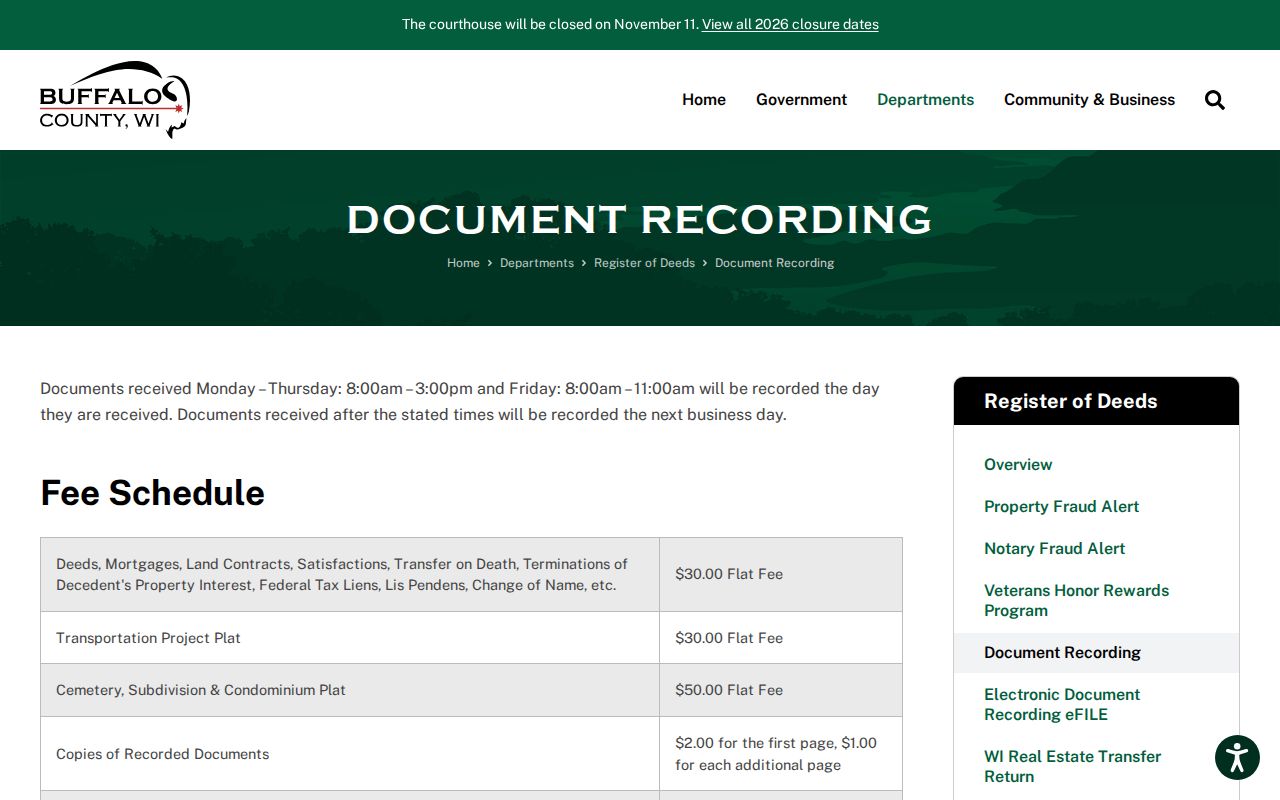
The fee table is a planning tool for copy requests. Ask the office about any search or remote-image charge it does not list.
Buffalo County Deed Search Options
Buffalo County offers two online document search products aimed at different users. Laredo is subscription-based for regular searchers. Package details come from the Register of Deeds. Tapestry EON is described as a public internet search for the occasional real-estate user. No membership is required. A non-member can pay by credit card. The county's online document-search page lays out the split between subscription access and public occasional search. Verify name fields, document filters, and image availability inside the portal itself, since the public page does not display them.
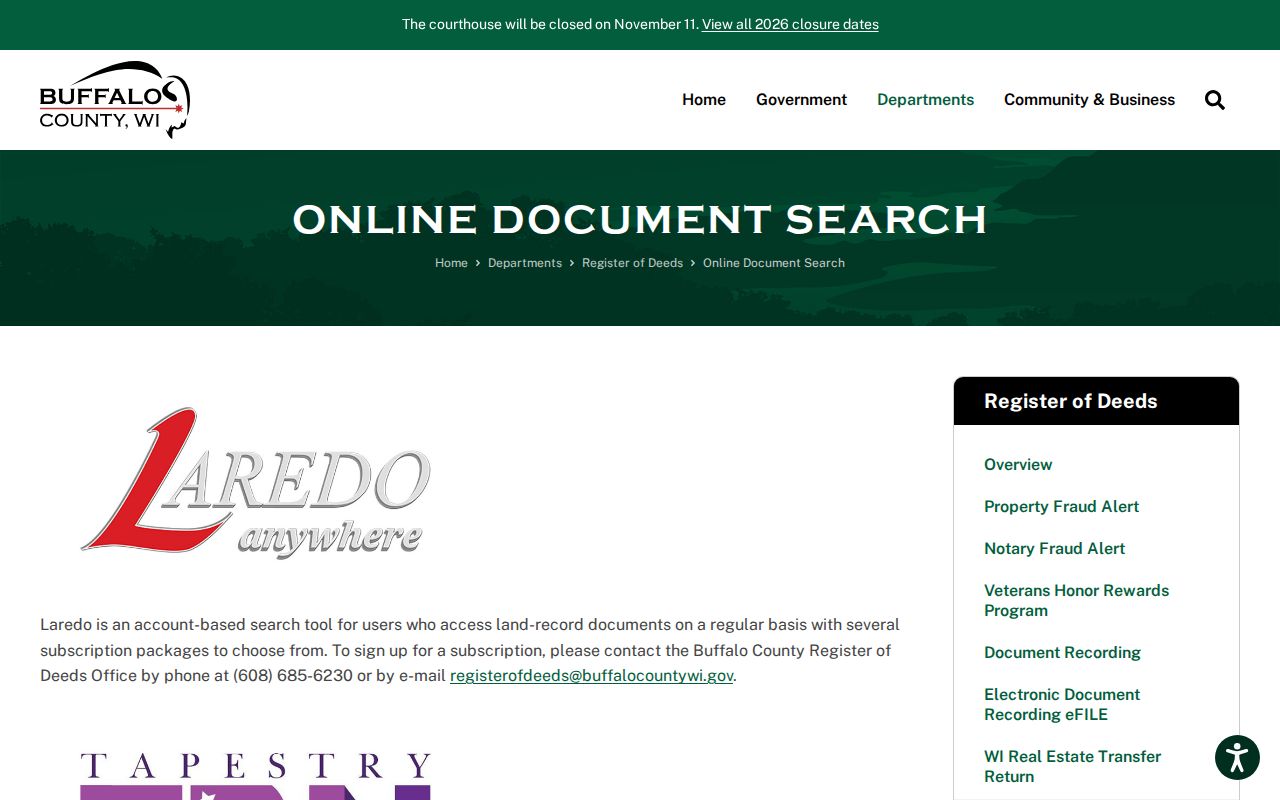
Absent results deserve a second look. Ask whether the record falls outside the portal's index or image span before concluding nothing was filed.
Buffalo County Liens and Court Files
Liens live in more than one Buffalo County office. The Register of Deeds holds mortgages, federal tax liens, and lis pendens. Mechanics liens and state tax liens go to the Clerk of Courts instead. A lis pendens signals an active lawsuit. Pull the civil case itself before assuming anything about the land. Special assessments and delinquent taxes need a look at the tax roll. A city record may apply as well.
Wisconsin Circuit Court Access covers circuit cases statewide. The local Clerk of Courts keeps the paper files and sells certified copies. A case index lists parties, case type, filings, status, and available documents. Confidential and juvenile matters stay sealed. Before closing a property question, search the right office for a later satisfaction or release. Then let a title professional read the whole chain.
Buffalo County's Older Deed Books
Older Buffalo County deeds take patience. The Buffalo County Historical Society holds microfilm of deeds from 1854 through 1887. It also holds probate files from 1854 through 1900. Its courthouse rooms sit on the third floor. That makes them a handy fallback when a chain reaches back before the online index. The collections also hold a naturalization index, family files, and local newspapers. They include plat atlases from 1878, 1896, 1914, 1930, 1955, and later. Bring surnames, a township or city, and a rough date, and ask about current access.
Buffalo County Historical Society staff can link a family name to a farm, estate, or subdivision. Microfilm and newspaper clues are only clues, though. The Wisconsin Historical Society's digitized 1914 atlas plots city, village, and township plats. It names the landowners on each plat. Treat it as a lead. Then confirm every transfer in the recorded deed or a probate instrument. The former-owner chain method shows how to work backward from the newest grantee.
Buffalo County's Fraud Alert
The Register of Deeds runs a free Property Fraud Alert. It matches submitted names against new Buffalo County recordings and sends a notice on any hit. It cannot stop a filing. Common surnames can also trigger matches about someone else entirely. Check the recording date and document type. Check party names and the legal description against the parcel you know. The county's fraud-alert page explains enrollment and its limits.
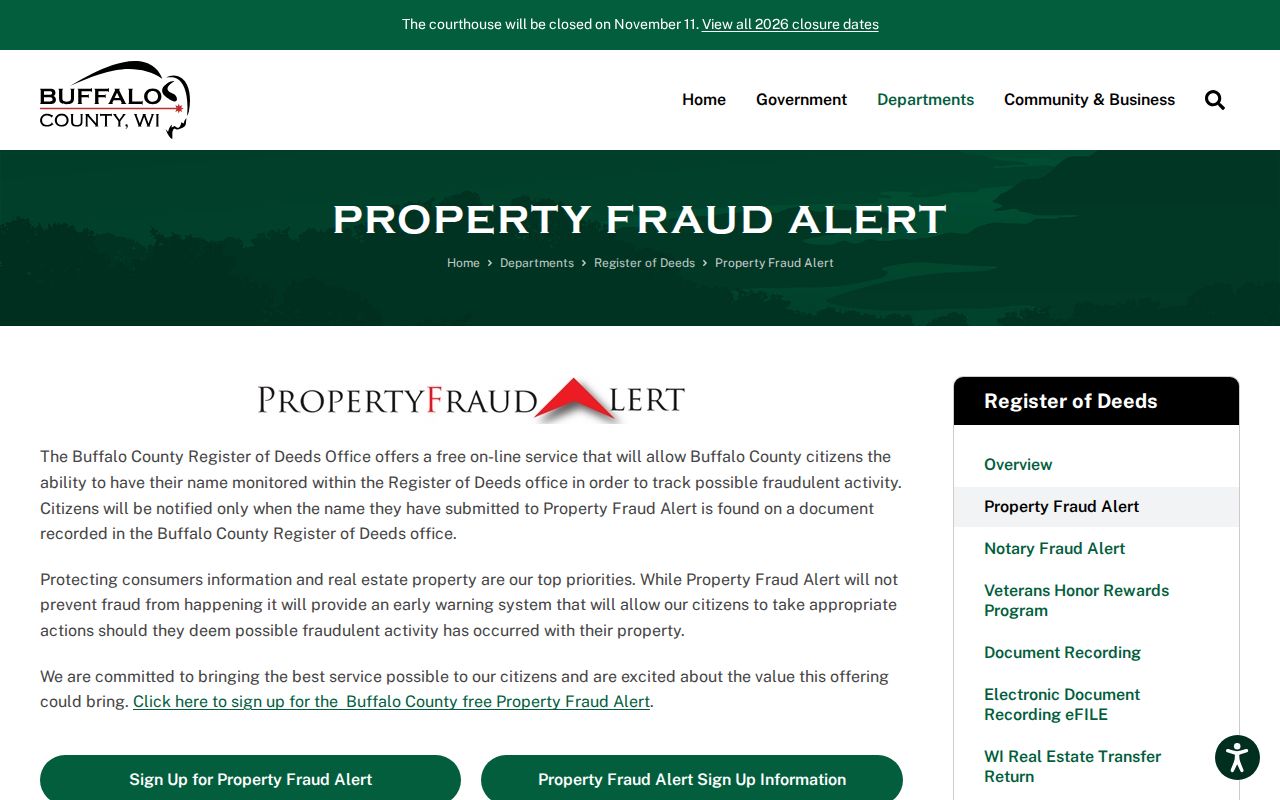
Note: Any alert is a prompt to inspect the filed document and call the custodian if something looks unfamiliar.
Buffalo County Recording Counter Hours
The Register of Deeds sits at 407 S. 2nd Street in Alma. Mail goes to P.O. Box 28, Alma, WI 54610. Public hours run 8 a.m. to 4 p.m. Monday through Thursday and 8 a.m. to noon Friday. Same-day recording has an intake cutoff of 3 p.m. Monday through Thursday and 11 a.m. Friday. Miss the cutoff and the instrument records the next business day. That schedule matters when a deal hinges on its recording date.
Call 608-685-6230 first to confirm availability and the recording category before you travel or mail anything. Fees can be paid with cash or a check made out to Buffalo County ROD, and electronic recording works for submitted documents. Filing an instrument is not the same as asking staff to draft it. The office gives no legal advice, prepares no deeds, and runs no title searches. For copies, supply the parties, instrument type, approximate date, and parcel or legal description. If the remote search stalls, ask whether an older paper or microfilm source applies and what copy format the office offers.