
Run a Buffalo County Property Search
Start at the county Tax/Assessment Info hub. It ties together the public parcel viewer, the deed search, and the Property Tax & Assessment Records Portal. One page covers most of a Buffalo County property records search. The tax portal opens with a guest sign-in. Its login screen warns that cookies and pop-up blockers must be enabled. A blank window often points to a browser setting rather than a missing record. The county confirms the interactive search tools exist. Its public materials do not spell out every field name and required format, so check those in the live portal.
An address can return a parcel. Copy the PIN, owner name, municipality, and legal description into your notes. Carry the current owner of record into the Register of Deeds index to find the latest deed. That index has its own search limits and image access rules. Treat a tax result as a clue, not proof of title. When the online search stalls, fall back on the map. You can also use the land-information help form or a direct request to the custodian.
- Open the county Tax/Assessment Info hub and choose the tax portal or map viewer.
- Search the physical address, then record the PIN and legal description shown with the parcel.
- Check the tax roll for owner, land and improvement assessment, tax year, districts, and charges.
- Carry the name or legal description into the Register of Deeds search for the latest recorded conveyance.
- Ask the relevant office for a copy or older record if the online index does not reach it.
Read a Buffalo County Search Result
A Buffalo County result card packs a lot into a few lines. The 2025 tax-list report lays out the county's own fields plainly: tax year, municipality, grouping, sort order, owner of record, property type, parcel or personal-property number, a tax-amount filter, property details, an alternate parcel number, and a CSV export. County materials describe the portal as carrying parcel, ownership, assessment, tax, and district data too. Field labels on the live card can shift, though. So treat the report list as your map. Inside the assessment record, keep land and improvement values separate from the tax amount. Charges and credits belong in their own column as well.
Watch for details that look like contradictions but are not. The mailing address may differ from the situs address. The tax municipality may not match the city in a postal address. Never assume the named owner lives on the parcel. Report codes carry meaning too. DC flags delinquent charges. FC is forest-crop. MF is managed-forest. OC is an occupational tax. SA is a special assessment. SC covers special charges. Each code is a cue to pull the actual tax bill or call the Treasurer. None of them explains itself.
| Owner of record | Ownership entry maintained with the assessment record; exact live label not published |
|---|---|
| Situs and mailing | Physical parcel location versus tax-bill destination |
| PIN | Parcel key shown on tax documents or available through the county |
| Assessment and tax | Land, improvement, personal-property, district, and charge data |
| Legal description | Deed description using a plat, lot/block, or survey calls |
| Last sale | Exact portal display was not confirmed; verify through the recorded instrument |
A clean search result is not the end of the story. It cannot guarantee that every deed or lien filing surfaced. It also cannot settle who holds clear title. Boundaries are another matter entirely. A property search will not establish a legal boundary or confirm who occupies a parcel. So read the recorded instrument, check for later releases, and bring in a surveyor or title professional whenever a legal conclusion rides on the answer.
Open the Buffalo County Tax Portal
The county's public tax portal opens with a guest sign-in instead of a parcel-results screen. Cookies and pop-ups must be allowed first. Once you are through guest access, pick the parcel or tax function that fits the clue in hand. Then save the PIN and tax year alongside the result. The county's own page describes the application as serving parcel and assessment records. It makes no promise that every live field appears in the online card. Nor does it promise that all historic data made it in. The Buffalo County Tax Portal guest sign-in page shows the access prompt and the browser requirements. Start there.
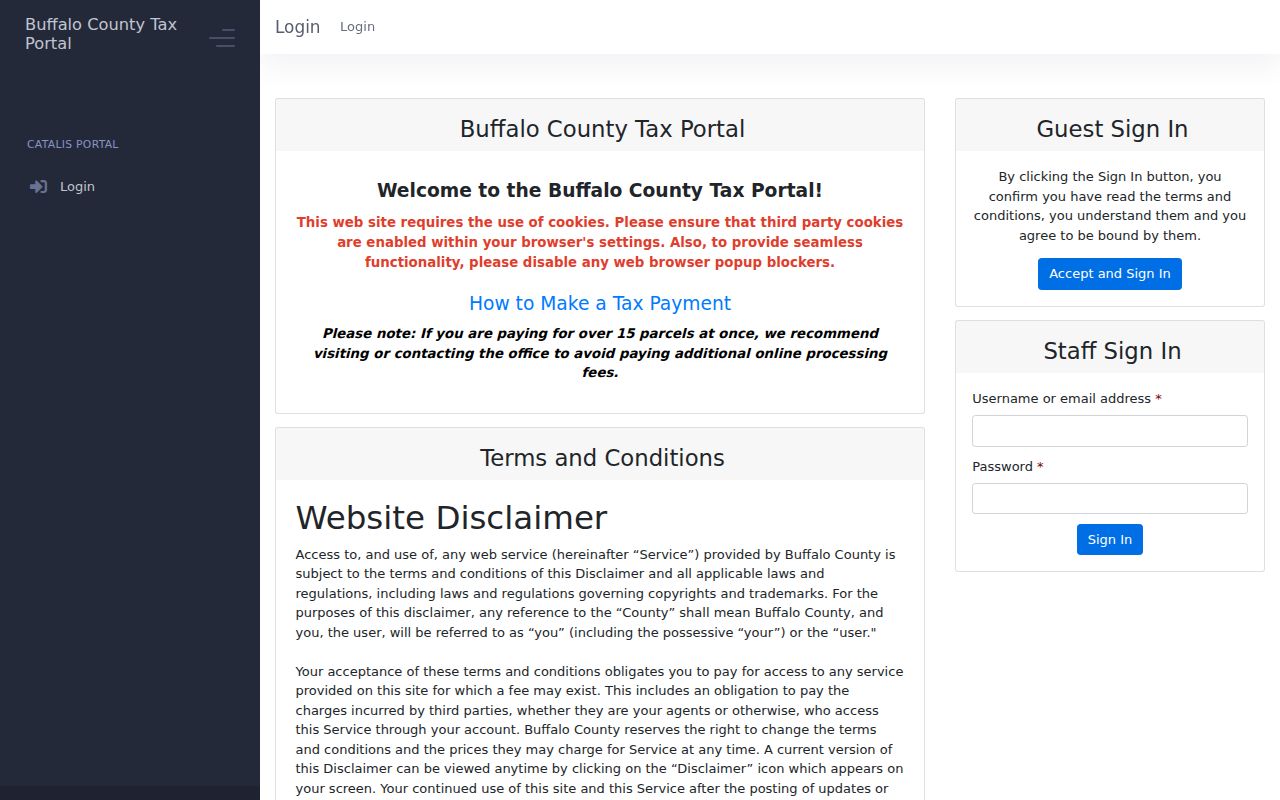
The sign-in window should open automatically. If it does not, adjust your browser's pop-up and cookie settings before assuming the parcel record is missing from the tax portal.
Choose the Right Buffalo County Clue
Start with an address when the property sits in town. Rural parcels and older deeds often lack a modern street number, though. Owner-name searches can pull up more than one parcel. That happens often where a surname repeats across a family or an entity holds title. A PIN is the strongest key. It works across county systems once you have it. Legal descriptions help bridge parcel splits and old plat names. Each clue fits a different job. Keep several on hand before you leave the portal.
| Search Key | Best For | Where It Works | Watch Out |
|---|---|---|---|
| Street or situs address | Locate the physical tax parcel | Tax Portal or map | Mailing city and tax municipality may differ |
| Owner name | Find a parcel or recorded role | Tax Portal; deed index | Similar names, trusts, estates, and LLCs need review |
| PIN or legal description | Bridge map, tax, and deed records | Tax bill, GIS, recorded instrument | Older deeds may lack a modern PIN |
Not a title search. A Buffalo County property search shows records held by separate custodians. It does not guarantee clear title or replace a title professional's review of the full chain and recorded releases.
Address Is Not a Mailing Address
A county record holds two different addresses. The situs marks the physical land. The mailing line routes the tax notice to a rural route, a post-office box, or an address outside Buffalo County. A city printed in that postal line is not proof. The parcel may still lie outside the city's legal boundary. Check the tax municipality and the map location first. Only then use a city name as a search filter.
The gap matters in a rural county. A route address may not match the parcel's legal description. Lead with the physical location when you know it. The address may return nothing. In that case try the owner name, the PIN, section-township-range, or the named plat. Staff can work from several of those clues through the GIS help form. Keep the mailing line in your notes. It may show where a tax bill went. Just do not read it as proof of occupancy.
Buffalo County Search by Section
Buffalo County's land-information form speaks the language of the public land survey. It collects township, range, section, quarter section, and quarter-quarter section. Address, PIN, plat, block, and lot round out the fields. Rural roads often lack a standard house number. Older transfers can predate today's address fields too. That is why the section-based approach works so well for Buffalo County parcels. Copy the legal description before contacting the GIS office. Pull it from a deed, tax bill, survey, or plat.
A help request goes further when it arrives loaded with clues. Include the owner name if you know it. Add the physical address and municipality. List every piece of the legal description you have. The form asks for your name and a reply email, with phone optional. Treat it as a fallback. It is not a guarantee that each item is searchable in a public parcel card. A reply can pinpoint the tax parcel. That gives you a stable key for the deed index and the assessment record.
The county's land-information request form lists the parcel clues that can supplement a street search.
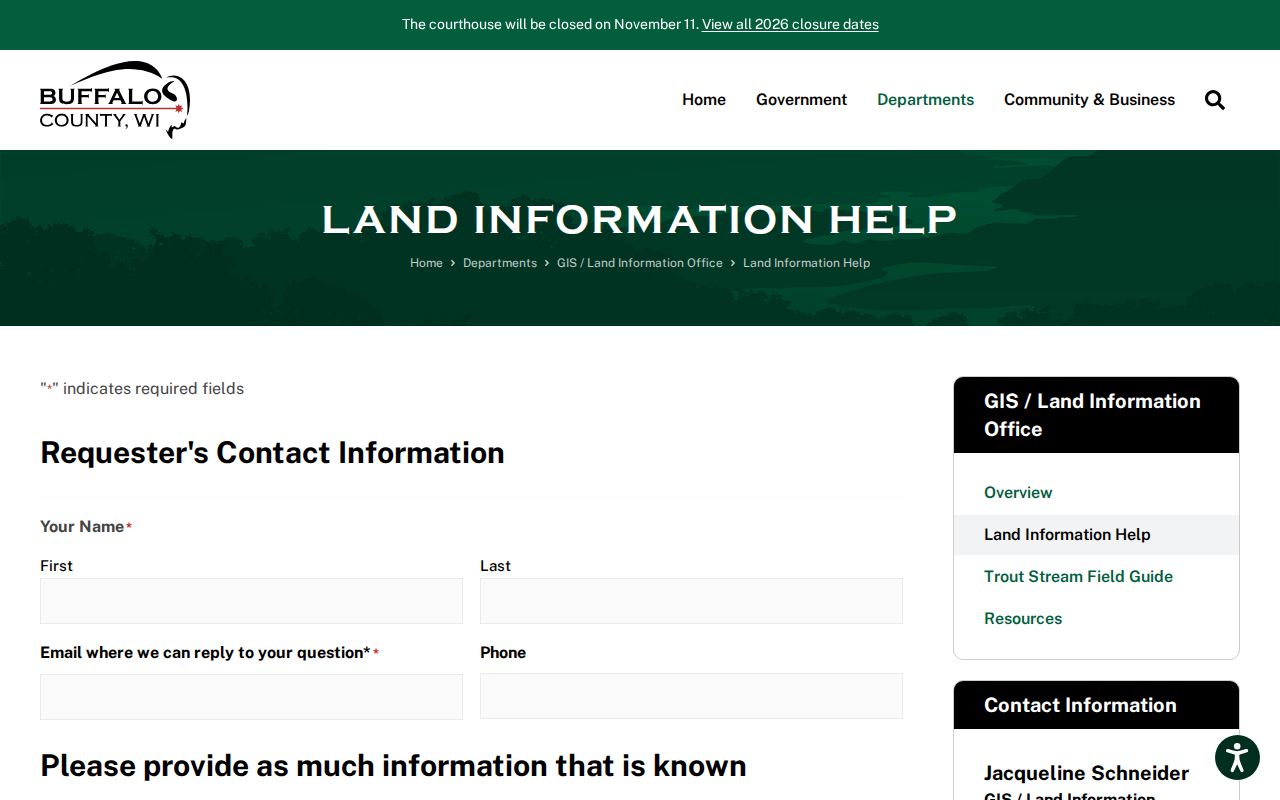
An address alone does not always land on the right parcel. Give the GIS office the section and plat details so the property search stays on target.
Buffalo County Tax Report Options
The annual tax-list report opens a different path into Buffalo County property records. The 2025 report lets you filter by year and municipality. You can sort by owner or parcel, select tax amounts, and print details. It can include an alternate parcel number and export a CSV. Those controls shine when you need a list for one town or one owner name. They cannot replace a single parcel's current bill or the deed behind an ownership change.
The report's codes flag delinquent charges. They also mark forest-crop and managed-forest land, occupational tax, special assessments, and special charges. A code is only a label. It is not a current balance. When a result matters for a sale or a tax question, open the parcel's individual county record. Contact the Treasurer about present status. The county also cautions that land-record modernization can leave gaps. Check any report against the custodian's latest figures.
Property detail and the alternate parcel number help. Use them when an older bill or assessor note shows a different identifier. The CSV option lets you sort a list outside the portal. Duplex printing is just a format control. Keep the original tax year and municipality attached to every exported row. Without those two values, a charge could be matched to the wrong roll. Narrow the search with the annual report. Confirm with the parcel's own record.
When a Buffalo County Search Misses
Some limits are simply built in. The county's public material does not spell out the tax portal's address-search format. It also stays quiet on owner-name behavior and the deed index's earliest online year. A blank result can mean many things. Spelling variants happen. Parcels get split. Addresses mismatch. The record may sit in older paper files. Or a tool may have hit its limit. Try another clue instead of treating one empty screen as final.
For a parcel that resists placement, use the map or the Land Information Help form. Older instruments and copy routes belong to the Register of Deeds. Laredo serves regular users. Tapestry EON handles the occasional public search. Another county office may hold the record. If so, file a focused Wisconsin Public Records Law request under Wis. Stat. §§ 19.31-19.39. Name the property, the record type, the date range, and your preferred electronic format. Ask for an estimate if copying or locating costs may apply.
In-Person Buffalo County Property Search Help
A remote search that cannot pin down a parcel may need a call or visit. A quick, focused contact can keep a request from landing with the wrong custodian. The Register of Deeds sits at 407 S. 2nd Street in Alma. Mail goes to P.O. Box 28, Alma, WI 54610, and the phone is 608-685-6230. Counter hours run Monday through Thursday, 8 a.m. to 4 p.m., and Friday, 8 a.m. to noon. Recording intake cuts off earlier: 3 p.m. Monday through Thursday and 11 a.m. Friday. Those cutoffs apply to documents submitted for recording. Call ahead about any same-day filing.
The County Clerk shares the courthouse address but keeps its own mailing address, P.O. Box 58, and phone, 608-685-6209. Its public hours are Monday through Friday, 8:30 a.m. to noon and 1 p.m. to 3 p.m. Court-file questions go to the Clerk of Courts. Mechanics liens, construction liens, and state tax liens are not Register of Deeds indexes. Deeds, mortgages, easements, and recorded plats are. Tell staff the record type and approximate date before you make the trip.
Genealogy works differently. The Register of Deeds offers appointment-based access Monday through Thursday, 1 p.m. to 3 p.m. For older chains, the Historical Society holds deed microfilm from 1854 through 1887. Ask which collection fits your date before requesting records. Keep the PIN, owner name, municipality, and legal description together. Those clues can save a second visit when two properties share a surname or a mailing city.