
Buffalo County Tax Record Fields
Taxes are part of the story in Buffalo County property records. A parcel links to an annual assessment roll and a tax bill. It also ties to districts, credits, and payment status. Want to search Buffalo County property records by address? Use a parcel number instead. Either way, start at the county Tax/Assessment Info hub. The Treasurer collects the taxes. The Real Property Lister, working with municipal assessors, keeps ownership and assessment data. Some cities and towns also keep their own special-assessment or permit files. Read each tax record for its own purpose. Then confirm balances and assessment questions with the office that maintains it.
| Field | What It Shows | Where |
|---|---|---|
| Land and improvement assessment | Separate value components in the county assessment data | Real Property Lister / local assessor |
| Tax year and municipality | Year and city, town, or village grouping | County report and tax record |
| Owner and parcel | Owner-name or parcel sort and alternate parcel number | County tax list |
| Districts and special items | School/special districts, special assessment, special charges | Tax portal, report, and bill |
| Tax amount status | Tax amount filter and delinquent-charge code | County report; confirm current balance |
A roll and a bill are related but different documents. An assessed value is not a deed price or a sale appraisal. The county report breaks out land, improvement, and personal-property information. Its codes cover several charge types: DC for delinquent charges, FC for forest crop, MF for managed forest land, OC for occupational tax, SA for special assessment, and SC for special charges. Before treating any line as an amount due, ask the Treasurer. Ask what it means right now.
Find a Buffalo County Tax Bill
Collection runs on a split calendar. The county tax-payment page explains how installments divide between offices. The first half goes to the municipal treasurer by January 31. The second half goes to the County Treasurer by July 31. Paying the wrong office can delay a check. Use the parcel's tax bill and municipality to pick the right recipient. Online, the county takes credit-card and e-check payments. The payment page warns of service charges. Check the current amount at checkout.
- Use the Tax/Assessment Info hub to open the county portal and search the property by its known parcel clue.
- Check the tax year, municipality, billed amount, and payment status on the actual record.
- Send first-half payment to the municipal treasurer and second-half payment to the County Treasurer.
- Ask the Treasurer about a delinquent amount and its current status before relying on a report code.
- Assessed value
- The value entry used in assessment and tax administration; not a sale appraisal.
- Municipal treasurer
- The local recipient for the first-half installment identified by the county payment page.
- Special assessment
- A separately identified charge shown in the report or bill.
- Delinquent charge
- A report code that signals a status to confirm with the Treasurer.
Question a Buffalo County Assessment
An assessment question starts with the local assessor and the valuation year. Buffalo County's Real Property Lister works with municipal assessors on the annual roll. So the right first contact depends on where the property sits. Compare the parcel description and the land and improvement entries. Also check the notice or bill for the year in question. If a parcel fact is wrong, bring proof. A deed, survey, permit, or other record can explain the change. There is no single countywide appeal deadline, meeting calendar, or Board of Review filing route. Never rely on a generic date. Ask the municipal assessor for the current review and appeal procedure. Get the deadline in writing. Keep the assessment notice. Keep comparable property information the assessor supplied. Also keep any recorded transfer that bears on the question. An appeal targets the assessment. The separate deed record settles ownership.
Appeal window. Buffalo County's public research materials do not publish a single countywide date. Confirm the current meeting and filing deadline with the assessor for the property's municipality before preparing an appeal.
Buffalo County's 2025 Tax List
The published 2025 tax list offers practical controls. Choose the tax year and municipality, sort by owner name or parcel, or filter for a tax amount. You can print property detail, add an alternate parcel number, or build a CSV. The output separates real estate from personal property and carries district and special-charge information. These choices narrow a county list well. Still, an exported row is not the final source for a current bill. Codes in the sample include DC for delinquent charges and FC for forest-crop. MF stands for managed-forest land and OC for occupational tax. SA is a special assessment and SC marks special charges. If a code appears, use the parcel and tax year to ask the Treasurer what is owed now or which office collected the item. A tax-list filter cannot prove a charge is unpaid. It also cannot show that a property faces a tax deed. The county's 2025 tax-list report displays the controls and a sample of the output fields.
Use the report to narrow a tax year and municipality. Then confirm the parcel's current account with the Treasurer.
Buffalo County's Split Payment Dates
The county payment page lists destinations as well as dates. The first half is due January 31 to the municipal treasurer. The second half is due July 31 to the Buffalo County Treasurer. Online, the county takes several payment types. These include Visa, Mastercard, American Express, Discover, and e-check, and fees may apply. To mail a check, make it payable to Buffalo County Treasurer. Send it to P.O. Box 28, Alma, WI 54610 for the county installment. Confirm the current bill and municipal contact before sending the first half. The county's tax-payment instructions show both due dates and the payment options.
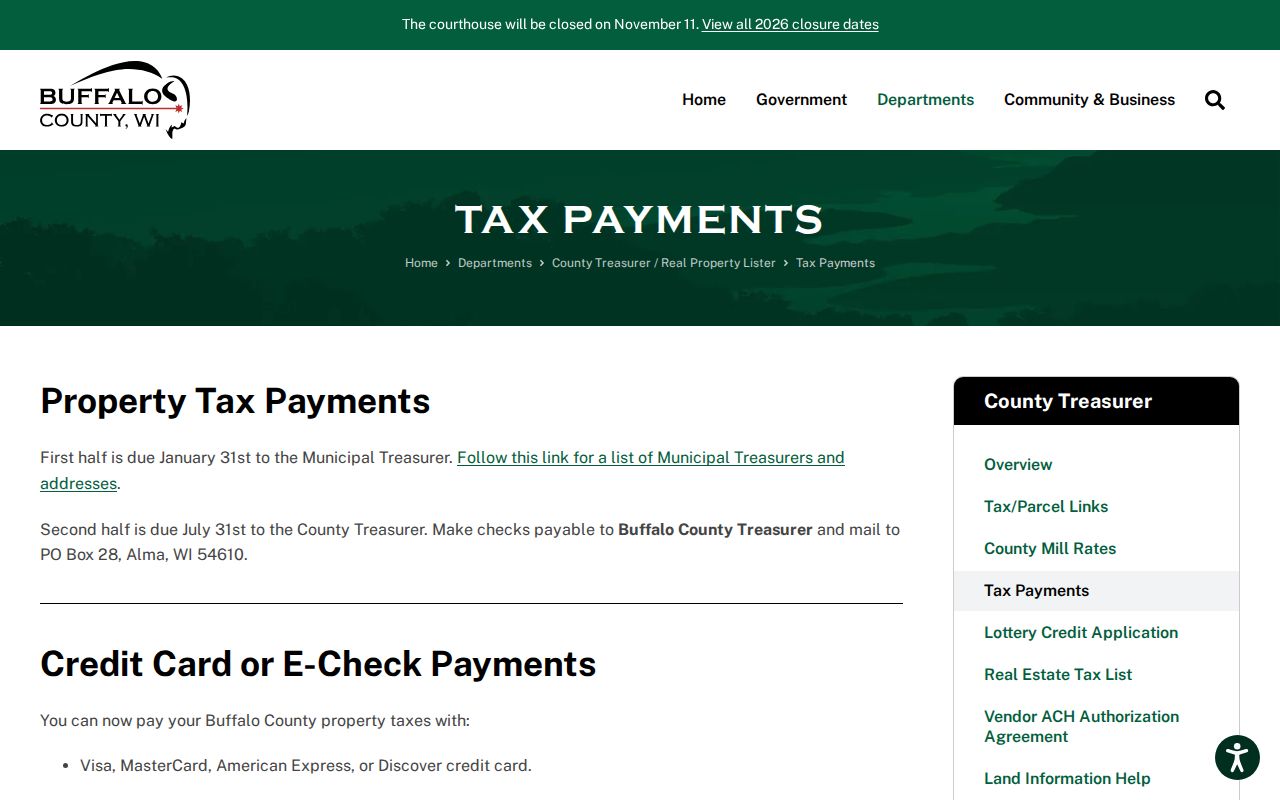
Follow the installment instructions for the bill year in hand, since collection is split between municipal and county offices.
Municipal Assessors Feed the Roll
Buffalo County splits this work. The Real Property Lister keeps the assessment database current. Municipal assessors add their values each year, and the combined result forms the annual roll. That division matters when a parcel shows a wrong value, property class, address, or legal description. Start local. The assessor for the city, village, or town where the tax municipality places the parcel is the right first call. The county Treasurer handles the tax account side and can explain payment status. Payment information is not a valuation record, though. Ownership changes reach the Lister once a deed is recorded with the Register of Deeds, and the Lister then coordinates the roll with local assessors. No average closing-to-roll delay is published. A fresh deed may outrun the annual tax record, so keep the recording date and parcel number handy when asking an office to reconcile the two.
Buffalo County Delinquency and Tax Deeds
Delinquency starts with the Treasurer. That office keeps postponed and delinquent property tax records and runs the tax-deed process once taxes sit unpaid for three years. The three-year mark is process, not prediction. Ask before acting. The Treasurer can confirm the current balance, any payments, postponements, and whether a tax-deed step is underway. A code on a published report is a clue, never a notice of sale. Court history lives elsewhere. The Wisconsin Circuit Court Access system shows public circuit-court files for a dispute or foreclosure case, and the local Clerk of Courts holds certified copies. Then check the deed itself. Any tax deed or other conveyance belongs in the Register of Deeds. That sequence keeps a tax account, a court action, and a recorded transfer from blurring together.
Credits and District Fields in Buffalo County
Buffalo County tax records carry more than rates. District information, lottery-credit context, special assessments, and special charges all appear in the assessment data. A credit changes the tax math on the bill. It does not rewrite a deed or set a market price. Forest-crop and managed-forest codes reflect how land is classified. Occupational-tax and special-charge codes point to different items entirely. Read the parcel description for the year in question rather than treating every code as a fee on the land. Special assessments often live locally. Mondovi, for example, lists the clerk/treasurer as the contact for special-assessment searches. Other charges may be held locally. Ask which public record supports an entry and whether it was paid, adjusted, or carried into a later year. To read a tax amount as a value measure, see the Buffalo County property value comparison.
Buffalo County Treasurer and Tax Payment Records
Every tax account holds two questions. What owner and value data does the roll carry? And has a payment actually been received and credited? The Real Property Lister updates ownership when recorded changes reach the Register of Deeds and builds the annual assessment roll with municipal assessors. The Treasurer collects taxes and tracks postponed, delinquent, and county installment accounts. A bill may still show a prior owner. Keep the recording date and PIN, and ask whether the annual record has caught up. No average update lag is published.
Installments split between offices. The first half goes to the municipal treasurer by January 31. The second half goes to the County Treasurer by July 31. Online county payments take Visa, Mastercard, American Express, Discover, and e-check, and service fees may apply. Mail the county half as a check payable to Buffalo County Treasurer, P.O. Box 28, Alma, WI 54610. Ask about first-half mailing or drop-off steps. Always cite the bill year and parcel number.
Save the receipt or confirmation number. Compare it later against the parcel's payment status. An annual tax-list row may flag an amount or a delinquent-charge code, but it cannot prove a recent check cleared or a postponement still stands. Call the Treasurer for a current balance, payoff, or tax-deed status. A disputed assessment goes to the municipal assessor. Ask that office for current review dates, since the county publishes no countywide appeal calendar.